
Manifesto 2024: Woman’s Place WANTS more
Manifesto 2024: Woman’s Place WANTS more
Women and girls exist as a distinct class of people who share common experiences and interests. The particular needs of women and girls, however, are often overlooked by political parties, or treated as of minor importance. In this manifesto we set out the areas where women and girls are currently being failed, and our programme for putting it right.
Woman’s Place UK
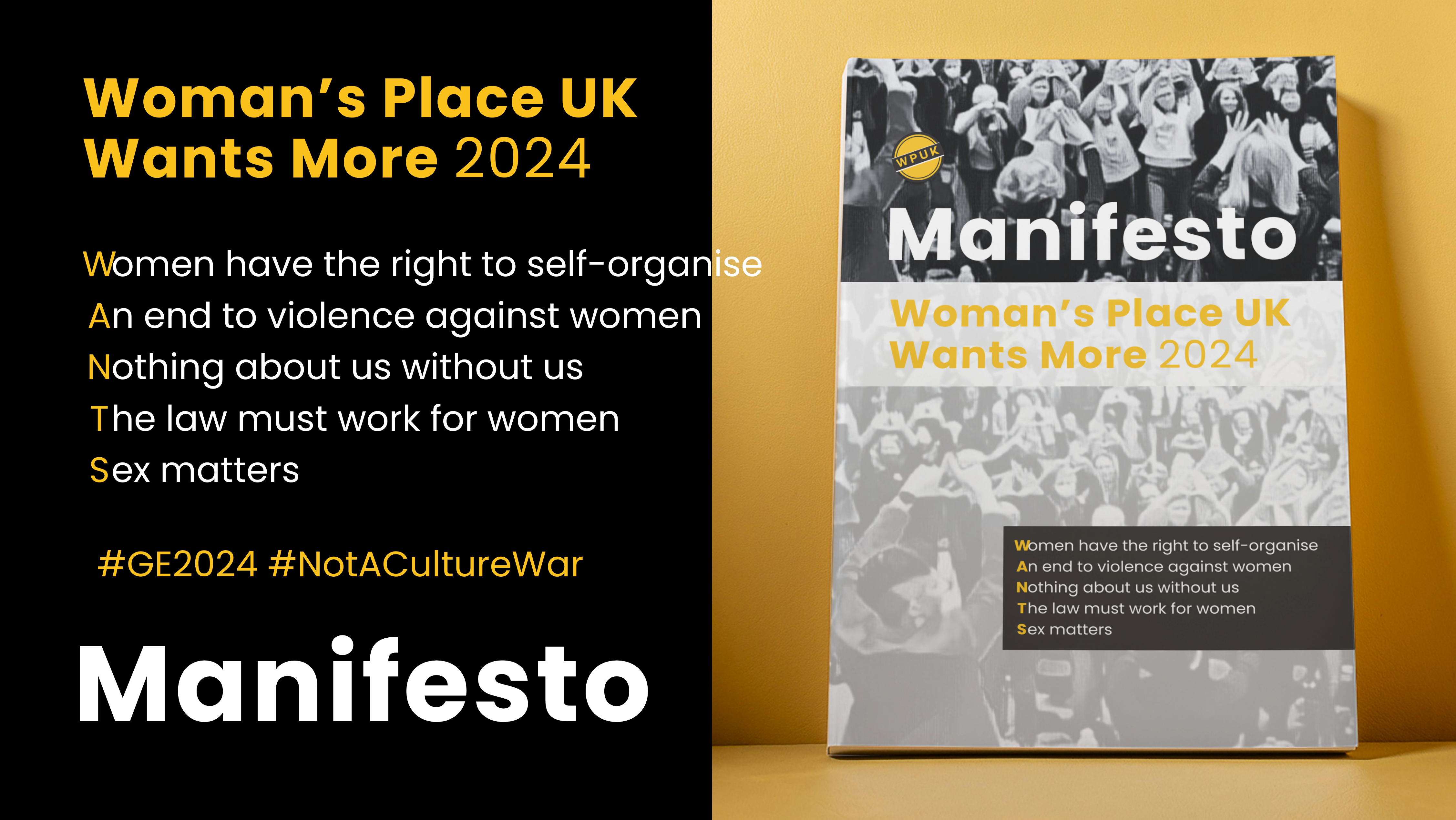
Our manifesto is based on our 5 WANTS.

Women have the right to self-organise
Women’s right to self-expression and organisation is neither supported nor protected
In the seven years since Woman’s Place UK was formed, we have seen the significant obstacles that women have faced in meeting and speaking out, in particular regarding their human rights, legal entitlement to equality and non-discrimination on the basis of sex.

This includes venues cancelling women’s meetings; harassment and intimidation of women who want to attend women’s meetings; feminist student societies being closed down; lesbian-only events cancelled; women academics not invited to/disinvited from conferences and other academic engagements.
The next government must
1 Ensure all public institutions uphold women’s human rights to freedom of association and freedom of expression.
2 Commit to upholding women’s lawful right to single-sex association, clubs, meetings, sports and pursuits.
3 Repeal laws that curb the right to free association and freedom of expression including the Police, Crime, Sentencing and Courts Act 2022 (anti-protest law) and the Strikes (Minimum Service Levels) Act 2023.

An end to violence against women
Violence, abuse and harassment are everyday experiences for women and girls
Men’s violence against women is a systemic problem.
Every 2.5 days, on average, a woman is killed by a man in the UK. Police figures show that rates of sexual and domestic violence and abuse have increased since 2020, yet only three in 100 reported rapes result in a charge by the police. Fewer than one in 100 of reported rapes result in a conviction.
Women are more likely to be subjected to sexual and domestic violence and abuse. Ninety-five per cent of those exploited in prostitution are female. Girls are at least three times more likely than boys to report experiences of child sexual abuse.
The Domestic Abuse Act 2021 does not protect migrant women with insecure immigration status. Older women are frequently written off as ‘confused’ and ‘unwell’ rather than victims of abuse by their current and former partners or adult sons. Disabled women are twice as likely to experience domestic abuse as other women, but there is a lack of specialist services to support them.
Successive governments have failed to invest in providing support for women and girls subjected to men’s violence. Competitive tendering often favours larger non-specialist organisations and has led to some organisations weakening their core principles to provide both gender-neutral and mixed-sex service provision.
The next government must
4 Implement an ambitious strategy to end men’s violence against women, girls and children (MVAWG) which fully recognises sex differences in victimisation, perpetration and impact.
5 Commit to sustained long-term investment, including the funding of specialist independent women-led organisations.
6 Ensure access to criminal and civil remedies in a timely manner and take action to increase prosecution and conviction rates for sexual and domestic violence and abuse.
7 End the iniquitous treatment of women with insecure immigration status in relation to benefits, housing and the protection of the law. This should include a firewall preventing statutory agencies, such as the police, from sharing data of a victim or witness of domestic abuse with Home Office immigration enforcement.

Art by Dr Bec Wonders Inspired by our meeting A Woman’s Place is in conversation: challenging men’s violence against women 17/10/20
8 Ensure every woman can access local, independent single-sex services for victim-survivors of sexual and domestic violence, abuse and exploitation.
9 Provide adequate housing options to enable women and children to live securely if they lose their homes due to violence and abuse.
10 Carry out a review of family court practices which discriminate against mothers, including the use of the disputed concept of ‘parental alienation’ .
11 Adopt the abolitionist model to tackle prostitution with psychological, practical and financial support to assist women to exit prostitution.
12 Take action to highlight and tackle the harms of pornography.
Nothing about us without us
Vital decisions affecting women are routinely made without involving women
It is clear that decisions by government, political, civil, legal and third sector organisations affecting women are routinely made without involving or including women. This results in wide-ranging policy and practice which does not reflect the reality of our lives, respond adequately to our needs, or accurately reflect our views.
The widespread adoption of sex self-ID by the back door, along with the care crisis and the lack of childcare provision are all representative of a culture that does not listen to women and does not consider or provide for women’s specific needs.
Government has a duty to ensure that women are treated as equal citizens and stakeholders in public life. Addressing the needs of women will result in better policies and laws for all.
The government must
13 Ensure women’s experience, expertise and views are central to all statutory, legal and governmental decision-making. Revise all policies that have embedded self-ID, and bias/discrimination towards women by their employers/colleagues for expressing their view that sex matters.
14 Establish specific government-level actions to increase the direct representation of women in decision making bodies and political parties. Where women are under-represented, the government should defend and promote the use of positive action including sex-based mechanisms such as all-women shortlists.
15 Implement the provision of properly funded, high-quality, universal childcare and adult social care free at the point of need. Those providing care for children or adults should receive pension or NI credits for this work.
16 Ensure all women have free access to NHS services including maternity and abortion services. They must also have the right to request a female clinician, carer or support worker, and access to female-only services for those with sex-specific conditions.
17 Establish equal resourcing of sports and physical activities for women and girls, taking into consideration their preferences and barriers to participation, and provision of female-only services, including single-sex clubs and teams, female staff and coaches, and single-sex changing facilities.
The law must work for women
The law fails women at every turn
Laws are often drafted without including or understanding the perspectives, experiences and views of women. The laws themselves are often poorly implemented and understood.
Crimes against women are downplayed or denied and women are routinely blamed for the crimes committed against us. Women are criminalised and imprisoned unnecessarily, their punishment disproportionate and/or cruel and often against the public interest.
This discrimination hits women from minoritised ethnic groups, those living in poverty or with disabilities even harder.
Effective action must be taken to tackle the institutional sexism, misogyny, racism and homophobia in the police and criminal justice system and to urgently address the poor investigation and prosecution of men’s violence against women.
The government must
18 Clarify in law that ‘sex’ means biological sex. Uphold and enforce the Human Rights Act (1998), the Equality Act (2010) and the Public Sector Equality Duty, including rights to single-sex provision.
19 Subject all new policy and legislation to meaningful equality impact assessments. The Equality and Human Rights Commission must be properly resourced so that it can provide robust guidance on equality law and ensure it is enforced.
20 Take concrete action to tackle the institutional sexism, misogyny, racism and homophobia in the police and criminal justice system and to urgently address the inadequate investigation and prosecution of men’s violence against women.
21 Urgently implement community-based sentencing for women offendors (as outlined in Corston & Angiolini), single-sex accommodation for women in the prison estate and an end to the self-identification of sex for offenders.
22 Provide adequate levels of legal aid for criminal cases, restore civil legal aid as well as aid for all immigration and asylum cases.
23 Enshrine women’s right to full bodily autonomy including access to abortion, which must be decriminalised. In relation to surrogacy, the government must resist calls for parental responsibility to be transferred to the intended parents at birth.

Sex Matters
Society ignores the material reality of women’s lives
Biological sex is a fact of life that must be recognised and taken into account in the organising of our society, its systems and its services. It must not be used as a reason for women to be held back or boxed in; it cannot be used to justify unfair or discriminatory treatment.
Good policy and practice must be informed by robust evidence.
The failure by successive governments to properly fund the care sector means that women bear the brunt of this work, either on low pay, or unpaid and with concomitant impact on women’s finances.
The gap in women’s pay and pensions must be addressed urgently with robust governmental and legal action. The current rate of maternity pay adds to the financial hardship experienced by new mothers and should be brought in line with other comparable European countries.
The final report of the Cass Review has highlighted the problems with the “affirmative approach” to gender dysphoria, which has led to too many teenage girls, often with multiple vulnerabilities, being encouraged to identify as boys and to take harmful medication such as puberty blockers and cross-sex hormones, or to undergo unnecessary surgery.
The Government must
24 Commit to the collection of sex disaggregated data and maintain the review of data collection on sex and gender within public bodies.
25 Commit to upholding fairness for women and girls by protecting female-only sports and physical activities, competitive or otherwise, at all levels and ages and across all settings – from schools and local authority gyms and leisure centres, to national clubs and associations. Government funding should be conditional on women and girls having a protected category.
26 Ensure that young people receive actively anti-sexist education in schools and colleges including high-quality Relationships and Sex Education (RSE). The outsourcing, oversight and auditing of education including RSE to unregulated providers must end.
27 Take specific and targeted action to achieve equal pay including compulsory equal pay audits and an end to occupational segregation.
28 Overhaul the system of Universal Credit, remove the two-child benefit cap and reduce the waiting time for payments.
29 Prohibit redundancy in pregnancy and maternity and increase the rates of statutory maternity pay and maternity allowance.
30 Fully implement the recommendations of the Cass Review and overhaul NHS Child and Mental Health Services (CAMHS) to ensure the needs of girls and young women are fully met. Extend the temporary ban on puberty blockers for under-16s and provide guidelines for schools to replace an affirmative approach to gender dysphoria with a watchful waiting approach.

PDF download Manifesto 2024: Woman’s Place WANTS more

Further reading on the history of lobbying to remove women’s sex-based rights from law and policy. Launched by WPUK and the University of Oxford

You must be logged in to post a comment.